Intro

About

In this first stage, the catalogue focuses on the modern and contemporary architecture designed and built between 1832 –year of construction of the first industrial chimney in Barcelona that we establish as the beginning of modernity– until today.

The project is born to make the architecture more accessible both to professionals and to the citizens through a website that is going to be updated and extended. Contemporary works of greater general interest will be incorporated, always with a necessary historical perspective, while gradually adding works from our past, with the ambitious objective of understanding a greater documented period.

The collection feeds from multiple sources, mainly from the generosity of architectural and photographic studios, as well as the large amount of excellent historical and reference editorial projects, such as architectural guides, magazines, monographs and other publications. It also takes into consideration all the reference sources from the various branches and associated entities with the COAC and other collaborating entities related to the architectural and design fields, in its maximum spectrum.

Special mention should be made of the incorporation of vast documentation from the COAC Historical Archive which, thanks to its documental richness, provides a large amount of valuable –and in some cases unpublished– graphic documentation.

The rigour and criteria for selection of the works has been stablished by a Documental Commission, formed by the COAC’s Culture Spokesperson, the director of the COAC Historical Archive, the directors of the COAC Digital Archive, and professionals and other external experts from all the territorial sections that look after to offer a transversal view of the current and past architectural landscape around the territory.

The determination of this project is to become the largest digital collection about Catalan architecture; a key tool of exemplar information and documentation about architecture, which turns into a local and international referent, for the way to explain and show the architectural heritage of a territory.

Aureli Mora i Omar Ornaque
Directors arquitecturacatalana.cat

credits

About us

Project by:

Created by:

Directors:

2019-2026 Aureli Mora i Omar Ornaque

Documental Commission:

2019-2026 Ramon Faura Carolina B. Garcia Eduard Callís Francesc Rafat Pau Albert Antoni López Daufí Joan Falgueras Mercè Bosch Jaume Farreny Anton Pàmies Juan Manuel Zaguirre Josep Ferrando Gemma Ferré Inés de Rivera Fernando Marzá Moisés Puente Aureli Mora Omar Ornaque

Collaborators:

2019-2026 Lluis Andreu Sergi Ballester Marianela Pla Maria Jesús Quintero Lucía M. Villodres Montse Viu

External Collaborators:

2019-2026 Helena Cepeda Inès Martinel

With the support of:

Generalitat de Catalunya. Departament de Cultura

Collaborating Entities:

ArquinFAD


Fundació Mies van der Rohe


Fundación DOCOMOMO Ibérico


Basílica de la Sagrada Família


Museu del Disseny de Barcelona


Fomento


AMB


EINA Centre Universitari de Disseny i Art de Barcelona


IEFC


Fundació Domènench Montaner.


ETSAB

Design & Development:

edittio Nubilum

Architecture for education in metropolitan Barcelona

  • Cap de setmana 
per Paolo Sustersic

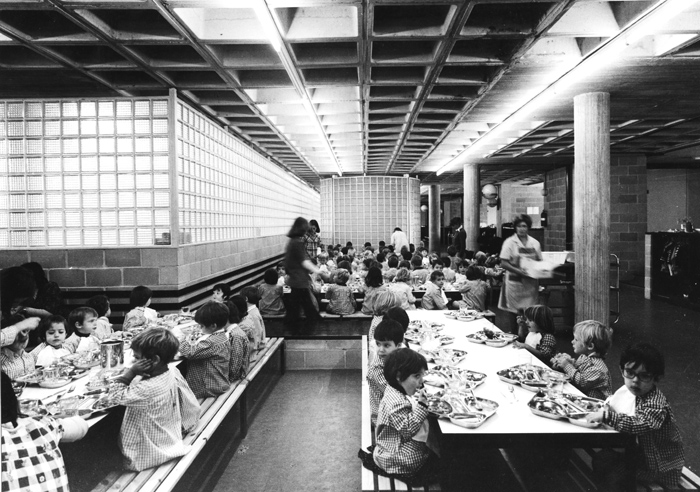
Architecture dedicated to different areas of education was an interesting field of experimentation for some architects from the late 1950s onwards. There were various reasons for this focus. The growth of the immigrant population, especially in the newly expanded areas on the outskirts of Barcelona and other cities in the metropolitan area, generated a demand that had to be met urgently, both by public and private initiatives.

Several schools run by such active teams as Martorell-Bohigas-Mackay and Giráldez-López Iñigo-Subías and, to a lesser extent, Anglada-Gelabert-Ribas fall into this category. In addition, from the 1960s onwards, a new Catalan school education project was also established by private institutions that considered the quality of architecture to be an integral part of the teaching environment. In some cases, the concept of the educational environment was extended to holiday camps near cities, designed to offer leisure activities in a community setting for schoolchildren; in the case of university students, this role was played by halls of residence. While in the aforementioned areas the initiative fell to municipal administrations and private institutions, in the field of higher education the promoter was the Francoist state through the Ministry of National Education and the universities. The two most relevant examples of these operations, which served both to enhance prestige and to control the university population, were the works carried out on the UB campus on Avenida Diagonal in Barcelona and the Autonomous University, located in Bellaterra, near the areas where the metropolitan area’s administrative centre was to be built.

This collection of works also provides an interesting overview of the different international architectural references associated with various brutalist and late modernist movements that arrived in Catalonia, as well as the materials used during the period, from the ceramic elements so prized for their realism by the so-called Escola de Barcelona to the different ways of using concrete, both in concrete and other materials.

m'agrada 10
no m'agrada 1
Tornar
Si no visioneu el mapa reviseu el vostre consentiment de cookies fent click aquí

Autors (21)