The traces left throughout history by passages, neighbourhoods, parks, streets, squares, monuments or murals in the city dedicated to peace are the physical evidence of the recurring need humans have felt to commemorate a concept that is universal in its formulation yet historically subjective in the ways it has been understood.
The city of Barcelona has a rich and varied collection of such representations, in which the ideal of peace is always the main character. For this reason, the opportunity to discover a whole series of interventions erected around this theme, in different periods and for different reasons, helps us to understand the extent to which a single idea —peace— can be constructed through sometimes very different readings.
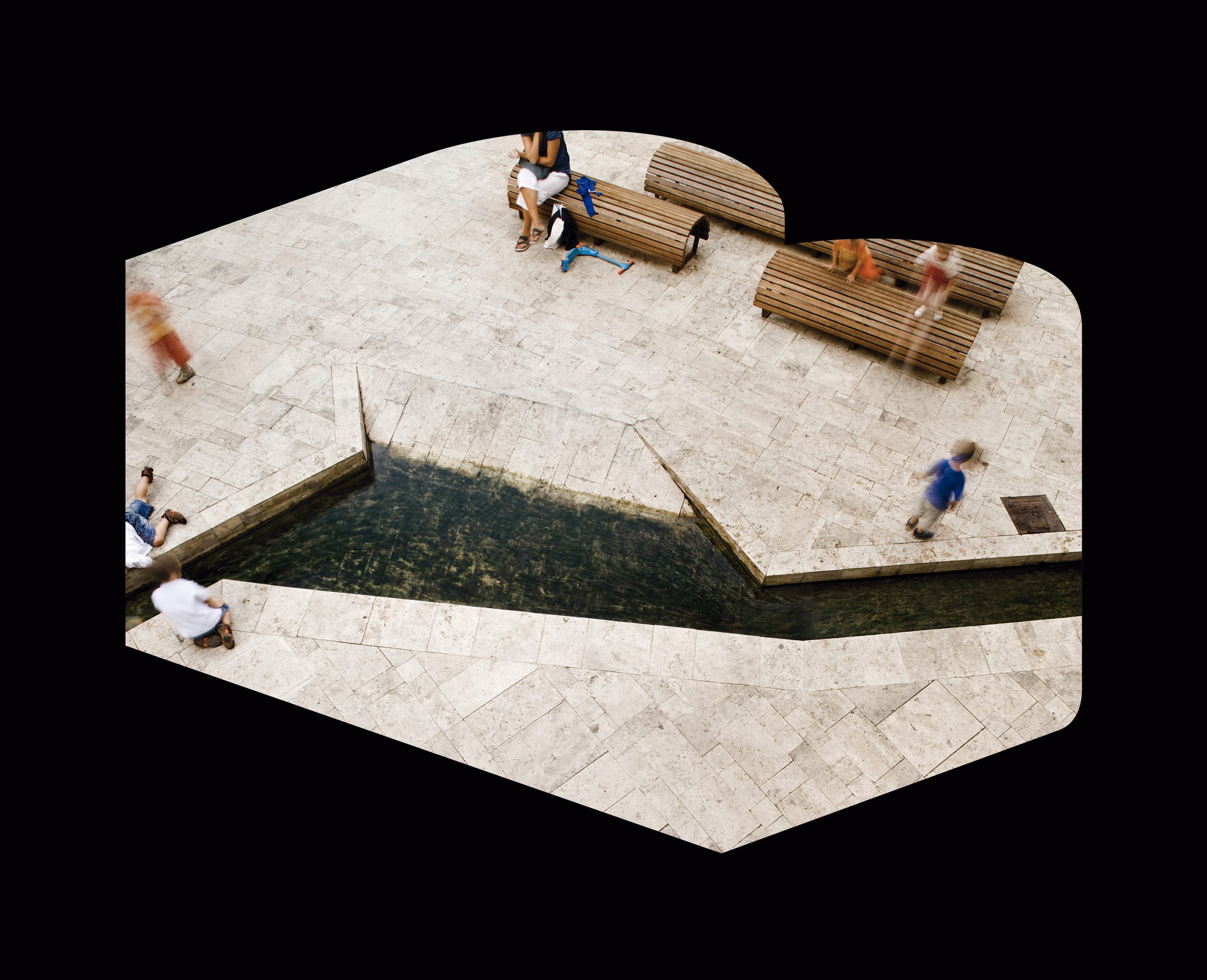
We begin this route on the southern bank of the Besòs River, very close to the site where the 2004 Forum of Cultures was held, where we can visit the Parc de la Pau, designed by the architects Iñaki Ábalos and Juan Herreros. During the weeks in which the event took place, the land now occupied by the park temporarily hosted what was known as the Peace Camp, where nearly a thousand children from around the world camped with the aim of “spreading the values of peace, diversity and coexistence”. The design and ephemeral construction of the camp were by the architects Mariona Benedito, Josep Benedito and Elena Saricu.
Heading north towards the district of Sant Martí, the housing complex that makes up the neighbourhood of La Pau, designed and built by the Obra Sindical del Hogar, was inaugurated by Franco in 1966 as part of the celebrations of the “25 years of peace” since the end of the Spanish Civil War. The neighbourhood, which suffered from serious construction defects caused by the use of high-alumina cement, was completely rehabilitated by ADIGSA in the late 1980s, under the structural direction of the architects Joan Margarit and Carles Buxadé.
Before continuing towards the oldest part of the city, it is worth stopping at the end of Rambla de Guipúzcoa, in the Clot district, where we find an important urban intervention in the form of a pergola designed in 1991 by the architect Bernardo de Solá. At its ends, this architectural element is accompanied by the sculptural group ‘Las pajaritas’, a contemporary replica of the work of the same name created in 1929 by the artist Ramón Acín, which can be seen in the city of Huesca. Beneath the Barcelona replica, installed in the same year as the pergola, a plaque reproduces the first article of the Universal Declaration of Human Rights: “All human beings are born free and equal in dignity and rights; and, endowed with reason and conscience, should act towards one another in a spirit of brotherhood.” Acín and his wife, Conchita Monrás, were executed in Huesca by Nationalist soldiers during the early days of the Spanish Civil War.
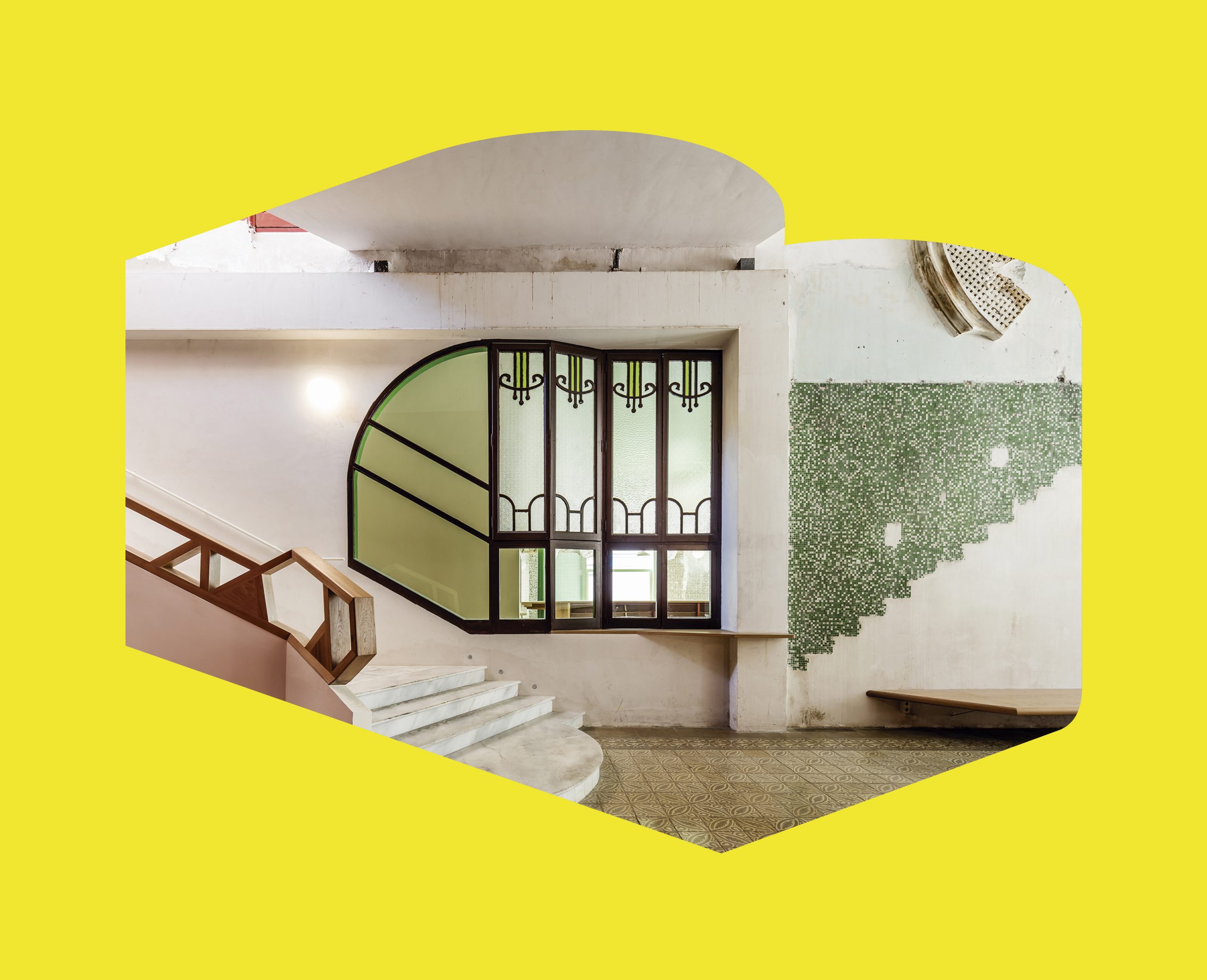
We continue towards the old town to stop at the Architects’ Association of Catalonia (COAC) and take a closer look at one of Picasso’s sgraffito murals. Among the various drawings that make up this intervention is a sardana of particular significance. ‘The Sardana of Peace’, as Picasso himself called it, remains as a memory of the one he drew in the summer of 1953 in Céret for his friends in the Communist Party and as the first work dedicated to what was intended to be the ‘Temple of Peace’, an artistic project centred on peace and reconciliation that unfortunately never came to fruition.
From the COAC towards Port Vell, walking down La Rambla and parallel to its final stretch, we can visit the Passatge de la Pau, an urban intervention created in the second half of the 19th century to free up space for new housing and to improve sanitary conditions. The passage is still home today to the EMBT studio of architects Enric Miralles and Benedetta Tagliabue. A few metres away, on the city’s seafront, we reach Plaça del Portal de la Pau, where the former headquarters of the Port Works Board stands, designed by the engineer Julio Valdés in 1903 and inaugurated in 1908. There, the architect Antoni Rovira i Trias designed a monument dedicated to peace to celebrate the end of the Carlist Wars, which has since disappeared.
We end the route in the Marina de Port district, in what was once the recreational area for workers at the Philips factory, formerly Lámparas Z. These gardens were designed in the 1960s by the Indonesian landscape architect Aafje Johanna Marie Vermeulen, who was also the wife of the Dutch director of the factory, Jan van der Harst. The vegetation comprises a wide variety of trees, many of them acquired during numerous trips to her homeland in Asia. In 2007, the remodelling of this space was inaugurated under the name Jardí dels Drets Humans (Garden of Human Rights), designed by the municipal architect Jaume Graells. The intervention reinforces the sense of a dense woodland through new planting and a route that includes thirty illuminated panels reproducing the thirty articles of the Universal Declaration of Human Rights (United Nations, 1948).
Once the route is complete, it is worth noting that beyond the urban spaces already mentioned, the city also contains a series of allegorical interventions dedicated to peace and human rights that can also be visited. These include places such as the so-called Jardinets de Gandhi, a small park inaugurated in 2000. Gandhi, although repeatedly nominated, never received the Nobel Peace Prize. Curiously, the sculpture of Gandhi permanently installed in the park is the work of Adolfo Pérez Esquivel, who did receive the prize in 1980 “for his commitment to the defence of democracy and human rights through non-violent means against military dictatorships in Latin America”. Other artistic interventions include the ‘Wall of Peace’, a mural painted collectively in 2023 to accompany the events of the World Forum for Peace held in Barcelona in November. Finally, as a complementary suggestion to the route, on Montjuïc hill, climbing towards the Olympic Ring, we find the ‘Bell of Peace’, installed on the occasion of the Olympic Games thanks to a donation from the German federal state of Baden-Württemberg together with a group of German companies. The bell, weighing almost seven tonnes, is mounted on a metal structure designed by the architect Beth Galí. Alongside the Olympic rings engraved in bronze, the word “peace” can also be read in several languages.